In this video it describes what free fall is and like in all my other videos, I chose this video in order to relate it back to things we do in every day life. Not that we go to the fair everyday but we have seen or either rode this ride before. He does a great job explaining how this ride is under free fall.
Thursday, October 24, 2013

Sunday, October 13, 2013
Newton's Second Law
I chose this video because it describes Newton's Second Law in a way that alot of people who love sports can understand it by relating it back the very sports we play. In this example, football. It deepened my understanding on what Newton's 2nd Law was.
Unit 1 Blog
Newton's 1st Law
In this first blog, we talked alot about Newton's First Law (which is an object moving or at rest will remain moving or at rest unless acted on by an outside force). In talking about this we opened up by first doing a project entitled the Hovercraft. In this project, we pushed a hovercraft that had 0N of friction to the ground and watched as it moved forward with a constant velocity. This followed Newton's 1st Law because when at rest it would not go anywhere but once we added force to the hovercraft, it continued to move forward without any variation of its speed. When Sean Wrinkle stopped the hovercraft, he was acting as the outside force to this whole law. So he caused it to go in a different direction.

Acceleration vs. Velocity
In talking about the speed of something however, we can't go on further without explaining the difference between acceleration and velocity. Acceleration is defined as the rate of change of velocity over the amount of time it took to change (written as a = Change in V/T). While velocity is the rate of speed in which something happens (written as v = D/T). An object can have a constant acceleration, and that is when it steadily increases its acceleration by the same number each second or so.
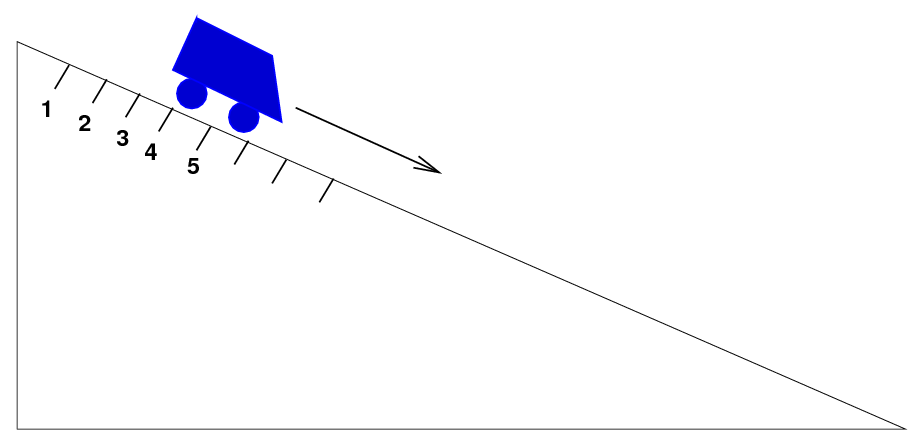
Acceleration in this picture would be if this truck continually accelerated each second by 2 m/s^2. If something had been going through a constant velocity it wouldn't be speeding up nor slowing down. It would stay at the same speed meaning it is an equilibrium. The formula for constant acceleration is d=1/2 at^2 while the formula for constant velocity is V= d/t.
Equilibrium and Inertia
An equilibrium is a state of rest or balance due to the equal action of opposing forces. So a car at rest, or an object that is traveling with a constant velocity would be an equilibrium. Inertia, is the property of matter by which it retains its state of rest or its velocity along a straight line so long as it is not acted upon by an external force. An example of this is if a boulder was rolling down a hill and you wanted to stop it, you would struggle and because it wants to remain rolling.

Formulas:
v = at (acceleration)
a = Δv/t (acceleration)
d = 1/2 at2 (distance = 1/2 acceleration squared)
v = d/t (constant velocity)
y = mx + b (slope of a line)
Difficulties As Well As Goals:
So far in physics class, I have struggled with fully understanding the concept of acceleration. I seem to struggle with the fact that if an object goes around a curb with a constant speed it is accelerating. In the beginning I seemed to struggle because we learned earlier that if something is at a constant velocity, it has an acceleration of 0m/s^2. It wasn't this concept I struggled with however, it was understanding that speed doesn't directly mean velocity. I feel that I need to improve my study habits and turning things in on time in order to increase my grade and understanding of things in class. This would be one of my goals for the class, improving the way I study and turning my assignments in on time for the remainder of the year.
My Lab Video:
Monday, September 23, 2013
Constant Velocity vs. Constant Acceleration
The purpose of this lab was to introduce us to the ideas of having a constant velocity versus having a constant acceleration. From this lab, I learned that having a constant velocity is having a speed that does not change how fast it is or the direction that it is going. However, having a constant acceleration means the object is accelerating at a constant rate but tends to get faster depending on the slope its on.I did both of these tasks by using simply a marble and a piece of chalk. To test out constant velocity, I rolled the marble on a flat surface and at every half second, I would mark where it was using the chalk.


This is an example of what the graph looked like from my results of marking where the marble was at every half second. To measure a constant acceleration, we did something alot similar to the first experiment, but instead of having a flat surface, we made an incline and let it roll like normal. This graph looked something like this:
The formula for constant acceleration is d=1/2 at^2 while the formula for constant velocity is V= d/t.
From this lab, I learned the difference between constant acceleration and constant velocity, I learned that whenever I see a straight lined graph it is because the object in motion has a constant velocity and whenever I see a curved line it is because the object has a constant acceleration.
Friday, September 20, 2013
Inertia
In this video, it shows an example of how inertia works in a car. Knowing Newton's 1st law, an object in motion/rest stays in motion/rest unless acted on by an outside force. In this example we see the car and you are in motion, and once the driver presses on the breaks you continue to want to go forward because you were already in motion. Inertia is the property of matter by which it retains its state of rest or its velocity along a straight line so long as it is not acted upon by and external force (dictionary.com).
Acceleration and Velocity
This is a video of the 2008 Olympic 100 meters finals in Beijing. This race shows acceleration because starting out of the blocks a runner must speed up by changing his velocity. If you noticed in Usain Bolt's last 20 meters when he knew he was going to win he stopped accelerating and driving, but he was still going the same speed. How is this possible? Usain Bolt decreased his acceleration yet his velocity stayed constant, thus allowing him to when the 100 meters .2 seconds before everyone else.
Wednesday, September 18, 2013
The Hovercraft
In physics class, we were given the opportunity to ride a hovercraft to get a feel for an object in motion that has no force pulling it. Riding a hovercraft was a unique experience. Before riding one I had no idea what to expect. It was weird because I'm so used to riding in a car or on other things that typical slow down to stop, however this did not. It kept moving at a constant speed until hit by an outside force. From this lab i learned that an equilibrium has 0N and this is seen if the object is moving at a constant speed or is staying still. A net force is the force that pushes an object that is measured in newtons (N). Based off the lab, on can hypothesize that acceleration all depends on the first phase. Based off the lab, you would expect to see the hovercraft having a constant velocity in the second phase when there is no push or pull on it. Some of the people riding the hovercraft however, went faster than others. This was because the bigger people were harder to push than the smaller people therefore I didn't have to exert much force.
Subscribe to:
Posts (Atom)