Wednesday, May 14, 2014

Unit 7

Magnetism

Magnetic forces are due to movement of charged particles and all magnets have a north and south pole.


Like charges,  magnetic poles can attract or repel without touching. Opposite poles attract and like poles repel. The space around a magnetic contains a magnetic field.


  • Magnetic fields, as seen above travels from north to south. 
  • Magnetic domains are a cluster of atoms rotating "out of control" 
    • Magnets work when these domains begin to align and rotate all in the same direction. 

Generators/ Transformers

A generator is a way to induce voltage by moving a coil. This is possible by rotating the cop in a stationary magnetic field. Generator take in mechanical energy and out put electric energy

  • Transformers are machines that transfer energy from a primary to a secondary circuit.
  • Transformers are used to keep current low, which produces less heat which in turn saves energy. It steps up or down voltage without changing energy.
  • Primary is the input and secondary is the output. Now if the primary and secondary have the same amount of turns the input and output alternating voltages will be equal. BUT if the secondary coil has more turns then the primary then alternation voltage in the secondary is greater than the primary thus the voltage must be "stepped up" and if the primary is greater than the secondary the voltage must be "stepped down".
  • The relationship between the primary and secondary voltages in relation to the number of turns is show by the following equation:
The rate in which energy is transferred is called POWER

  • (Voltage X Current)primary = (Voltage X Current)secondary


Thursday, May 8, 2014

Unit 6 Blog Reflection

Charges:

  • opposite charges attract
  • like charges repel
    • Three Ways to Charge an Object
      • Contact
      • Friction (steals electrons)
      • Induction (charge without electrons)
Polarization:
  • Coulomb's Law: the force between any two charges is inversely proportional to the distance
  • Conductors: allows charges to move throughout an object
  • Insulators: stop charges from passing through the object
(In the picture, you see the opposite charges attracting through polarization)
This process happens because:
  • Opposite charges attract this a negative charged balloon attracts to the positive wall which enables it to now stick on the wall. It's all about the spreading of charges. 
Voltage:
  • Voltage is the charge difference over a unit of charge which is also known as the potential difference

Motor Blog

The motor performs a few different tasks:
  • The Battery-Provides the electrical energy of the motor
  • The coil of Wire-Carries current.
  • The Paperclip-Connects and holds the coil of wire to the positive and negative ends.
  • The Magnet-Aligns electrons in wire.
Joey scraped the outside layer of the wire (which will rests on the paperclip) in entirety at both ends of the wire.  We did this because if there was a steady current flowing through the wire the motor would not turn all the way around.  It would turn to halfway and then stop.  We scraped half of one side and the whole of another, which made it so that the the current would be across the the magnetic field would be up and the force would turn the motor. Therefore the motor would not be turned back flat after it was spinning we stripped half it would not be pulled flat and it would continue to spin around.

The Motor turns because the current is down the wire, the electromagnetic force is up, and the force spins the motor sideways.  If the wire was completely striped the force would flip and it would spin back resting sideways; because half of the wire is striped, the current will stop and the coil will flip the rest of the way around until the current reconnects.  By this time when there force on the motor it be in the right direction to spin the motor. 


Tuesday, March 4, 2014

Mousetrap Car Report

Micheal and I finished 3rd to last with a time of 6.63 seconds.

9

Physics of the Mousetrap Car


  • Newton's 1st law states that an object in motion stays in motion unless acted on by an outside force. The outside force in our experiment was friction or shall I say the lack if friction. Without friction our car would not move forward, however once adding friction to the car it traveled 5m. Newton's 2nd law says that force equals mass over acceleration. In order for the car to accelerate, Micheal and I needed to try to decrease the actual velocity of the car.Newton's 3rd law is every action has an equal or opposite reaction. The car pushed on the ground backwards, therefore we see that the ground pushed the far forward. 
  • The first type of friction was the friction between the brass rod and the disks. This was really important because our front wheels wouldn't be able to rotate if it hadn't. The second type of friction was caused by the balloon that was placed over the wheels. This allowed the car to start. We had problems getting the car to move at first but once we put the tape and balloons on the car the friction caused it to to propel forward. We wanted as much friction on the back wheels as possible because the more it pushed on the ground the more the ground pushed back on the car.
  • Micheal and I   needed four wheels on the cart in order to make it balanced. Also, we decided to use cds so that the cart could move faster, because if we decided to use large wheels the cart would move slower due to the fact that the diameter is larger and the RPM would be much slower.
  • The further back we put the lever arm the more potential energy the car had. This potential energy was then converted into kinetic energy which caused the car to move forward as we set the mousetrap.
  • Our lever arm was short, which may have something to do with the inconsistency of our car or even the velocity of our car. 
  • The role of Rotational Inertia was how fast the wheels rotated. Rotational velocity played a role of how much time it took our car to cover the five meters, or how fast the wheels turned on the axle. Tangential Velocity meant how fast our cars wheel actually moved.
  • We really can't measure work because work is force by distance where my group forgot to measure the actual distance and we did not know the force. We could not measure potential or kinetic energy either, for one needs a height to have potential energy, and we didn't and two one needs a velocity to measure kinetic energy, and we did not have that either.


Tuesday, February 18, 2014

Unit 5 Blog Reflection

In this unit, we talked a lot about work and power. 
The formulas are:
Work = Force * Distance (where force and distance must be parallel and must be proportional)
Power = work/time 
Work In = Work Out
Fin * Din = Fout * Dout

If we were to have a 30N box, and had to travel a distance of 2m in 3 seconds, how much power do I need? How much work is done?

In order to solve this, you must solve for work first so, you use Work = Force * Distance
          Work = F * D
          Work = 30N * 2m
          Work = 60J (work is measured in joules)
Now I can solve for power using, Power = work/time
           Power = work/time
           Power = 60J/3s
           Power = 20W (power is measured in watts)


Work also equals the change in Kinetic Energy.
Kinetic Energy is the energy of movement and written as KE.

The Formula for KE is:

KE = 1/2 m v²
∆KE = KE final - KE initial (this is another way to solve for work)


 Then there is potential energy. Potential energy is the lowest point in which an object can be located. Potential Energy (PE) and Kinetic Energy (KE) are inversely related to one another. 

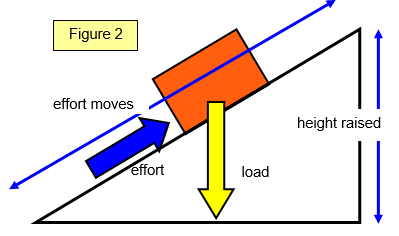
Machines are used in order to make the force in work easier. These machines range from inclined planes to pulleys. An example of how inclined planes help decrease the force in the object is shown below.


If I were to have a 50N box and needed to lift it 1m its force would be to much for me to be able to lift, so I would use a ramp that is 10m long which is the new distance and knowing work in = work out I would only need to use 5N of force.  Machines are used to make your life much easier.

I didn't really struggle this semester, I didn't do well on a major quiz however, but that was due to me being lazy and not checking back over my work. I am feeling pretty confident about this test however. I also managed to meet my goal for this unit which was turn in all of my homework, and I plan to make that my goal for the next unit as well as getting at least a B on the test. Now here is a video my group made about machines.


Friday, February 14, 2014

Machines and Inclined Planes

I chose this video because it show a hands on experiment being done on the project which makes it easier to understand. He also shows us using many tools for us to see for ourselves opposed to just listening and believing him based off what we hear.


Friday, January 31, 2014

Unit 4 Blog Reflection

I. Rotational and Tangential Velocities
II. Rotational Inertia/Conservation of Angular Momentum
III. Torque
IV. Center of Mass/Gravity
V. Centripetal/Centrifugal Force

I. Rotational Velocity: Number of times you rotate per unit of time (Angular Speed)
   Tangential Velocity: The speed of something moving around a circular path
   Linear Velocity: The same as Tangential Speed


Less rotational inertia=easier to spin

This Unit told us that the center of a rotating circle moves slower than the outer parts of that circle. This is because they are rotation with the same rotational velocity, however, once you look on the outside which is much larger than the inside, you have to wander how it stays balanced or keeps up with the inside. It has more ground to cover therefore it goes faster.


II. Rotational Inertia: It is the property of an object to resist changes in spin
Lots of rotational inertia = harder to spin
A little rotational Inertia = easier to spin


Who is spinning faster, the one at the left or the one at the right?
Well the one on the left is because she is decreasing her rotational inertia by bringing her arms in which makes her rotate much faster than the one on the left who has her arms out.

Conservation of angular momentum means:
total momentum before = same momentum after
R.I. x R.V. before = R.I. x R.V. after
So if I have a.... R.I. x r.v. = r.i. x R.V.
angular momentum = rotational inertia x rotational velocity

III. Torque: something that causes rotation
      Torque = Force x Lever arm ( where the lever arm is the distance from the axis of rotation)
The bigger the lever arm the less force it takes to put into an object

IV. Center of Mass: the average position of an objects mass
      Center of Gravity: when gravity acts on the center of mass
This is why in football we bend our legs because one, we lower our center of gravity which makes it harder for us to fall over and two other players are bending their legs, but whoever gets their center of gravity the lowest, they will run over their opponents.


V. Centripetal/Centrifugal Force
     Centripetal force is the force that helps us turn. It does this by pulling us inward while we are wanting to go outward.


This unit seemed to be very interesting to me. Although I did reach my goal of understanding the material alot  better and actually paying attention in class, I feel that I need to do that alot often. As seen in the torque lab, I found the meter stick problem really challenging, however after constantly practicing it, I feel that I have mastered that concept. Physics is seen in everyday life, and more specifically, rotation is seen in everyday life, so this helped me understand something from real life.